动态代理
0. 简介
代理模式有两种形式:静态代理、动态代理。
1. 类图
图片来源网络
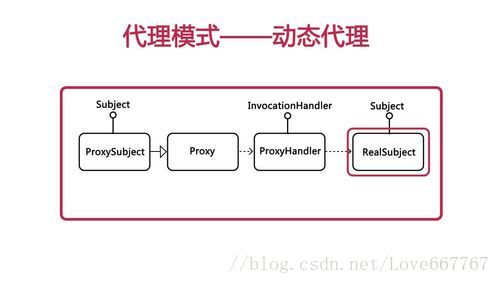
2. 示例
使用JDK中的Proxy类实现动态代理类的创建;
Proxy.newProxyInstance(ClassLoader loader, Class<?>[] interfaces, InvocationHandler handler);
一般的用法:
public void proxy() throws Exception {
PlayProxy handler= new PlayProxy();
IPlay proxy= (IPlay) Proxy.newProxyInstance(IPlay.class.getClassLoader(), new Class[]{IPlay.class}, handler);
proxy.play("篮球");
}
interface IPlay {
void play(String name);
}
class PlayProxy implements InvocationHandler {
@Override
public Object invoke(Object proxy, Method method, Object[] args) throws Throwable {
System.out.println("method=" + method + " , args=" + args[0]);
return null;
}
}
- 1
- 2
- 3
- 4
- 5
- 6
- 7
- 8
- 9
- 10
- 11
- 12
- 13
- 14
- 15
- 16
- 17
- 18
- 19
- 20
- 21
输出结果:
method=public abstract void com.example.demo.IPlay.play(java.lang.String) , args=篮球
由上面可以看出,虽然动态代理生成了接口的代理对象,但是代理类中没有实际的处理逻辑,而接口的方法也是没有实际处理逻辑的,所以要添加处理逻辑,只能在PlayProxy.invoke()中添加,这就增加了代码的耦合性。
注意: 跟静态代理相比,动态代理要少写一个代理类,因为该代理类可以通过Proxy.newProxyInstance() 方法获得。
这里涉及到三个类:
1. IPlay
2. StudentPlay
3. PlayProxy
public void proxy() throws Exception {
StudentPlay student = new StudentPlay();
PlayProxy handler= new PlayProxy(student);
IPlay proxy= (IPlay) Proxy.newProxyInstance(IPlay.class.getClassLoader(), new Class[]{IPlay.class}, handler);
proxy.play("篮球");
}
interface IPlay {
void play(String name);
}
class StudentPlay implements IPlay {
@Override
public void play(String name) {
System.out.println("StudentPlay.play(),name=" + name);
}
}
class PlayProxy<T> implements InvocationHandler {
T target;
public PlayProxy(T target) {
this.target = target;
}
@Override
public Object invoke(Object proxy, Method method, Object[] args) throws Throwable {
System.out.println("method=" + method + " , args=" + args[0]);
Object result = method.invoke(target, args);
return result;
}
}
- 1
- 2
- 3
- 4
- 5
- 6
- 7
- 8
- 9
- 10
- 11
- 12
- 13
- 14
- 15
- 16
- 17
- 18
- 19
- 20
- 21
- 22
- 23
- 24
- 25
- 26
- 27
- 28
- 29
- 30
- 31
- 32
- 33
输出结果:
method=public abstract void com.example.demo.IPlay.play(java.lang.String) , args=篮球
StudentPlay.play(),name=篮球
3. 源码分析
源码基于JDK1.8
public class Proxy implements java.io.Serializable {
/** parameter types of a proxy class constructor */
private static final Class<?>[] constructorParams = { InvocationHandler.class };
public static Object newProxyInstance(ClassLoader loader,
Class<?>[] interfaces,
InvocationHandler h) throws IllegalArgumentException {
Objects.requireNonNull(h);
final Class<?>[] intfs = interfaces.clone();
final SecurityManager sm = System.getSecurityManager();
if (sm != null) {
checkProxyAccess(Reflection.getCallerClass(), loader, intfs);
}
Class<?> cl = getProxyClass0(loader, intfs);
try {
if (sm != null) {
checkNewProxyPermission(Reflection.getCallerClass(), cl);
}
final Constructor<?> cons = cl.getConstructor(constructorParams);
final InvocationHandler ih = h;
if (!Modifier.isPublic(cl.getModifiers())) {
AccessController.doPrivileged(new PrivilegedAction<Void>() {
public Void run() {
cons.setAccessible(true);
return null;
}
});
}
return cons.newInstance(new Object[]{h});
} catch (Exception e) {
}
}
}